(Recommended LinkedIn Cover Image format: 16:9 ratio, rendered from official Microsoft Azure Architecture Stencils)
1. Executive Summary: The London Floor Reality Check
At the Microsoft Frontier Tour at ExCeL London, Satya Nadella delivered an architectural reality check that reframed the enterprise roadmap:
“Scaling laws produce more powerful models that become new forms of insiders—nested black boxes.”
Walking the floor at ExCeL and consulting with enterprise CTOs and cloud architects, the same pattern emerges: over 80% of enterprise AI initiatives remain trapped in pilot purgatory. The failure is rarely model intelligence. The breakdown is architectural: teams keep building monolithic, single-prompt conversational prototypes.
In an unconstrained prototype, developers routinely bundle three mutually incompatible tasks into a single agent prompt:
- Parsing third-party supplier contracts, freight clauses, and co-packer SLAs from unstructured documents.
- Querying analytical enterprise data warehouses for line capacity, changeovers, and equipment metrics.
- Mutating transactional ERP schedules in SAP S/4HANA or Dynamics 365.
In enterprise infrastructure, granting a single autonomous system broad access to read commercial contracts and write financial transactions is operational negligence. If a prompt injection attack, hallucinated measure, or unhandled schema drift compromises that agent, the blast radius spans the entire enterprise estate.
This advisory examines an enterprise reference implementation for an international FMCG packaging network coordinating 14 contract packaging facilities (“co-packers”). When an acute raw material shortfall triggered an imminent £10M+ retailer delivery penalty, we bypassed fragile single-prompt automation. Instead, we architected a hardened 3-agent pipeline governed entirely by Microsoft Graph (v2.x) and Entra ID Workload Identities, grounded in Fabric IQ Tabular Model Definition Language (TMDL), preserved in Azure Cosmos DB Decision Memory, and locked by a Non-Negotiable Human Dual-Signature Gate.
2. Segregation of Duties: The 3-Agent Architecture
The fundamental rule of enterprise agent engineering: authority must be explicitly segregated from capability. Rather than building a generalist bot, we decomposed the business process into three distinct, specialized agents operating within least-privilege security perimeters:
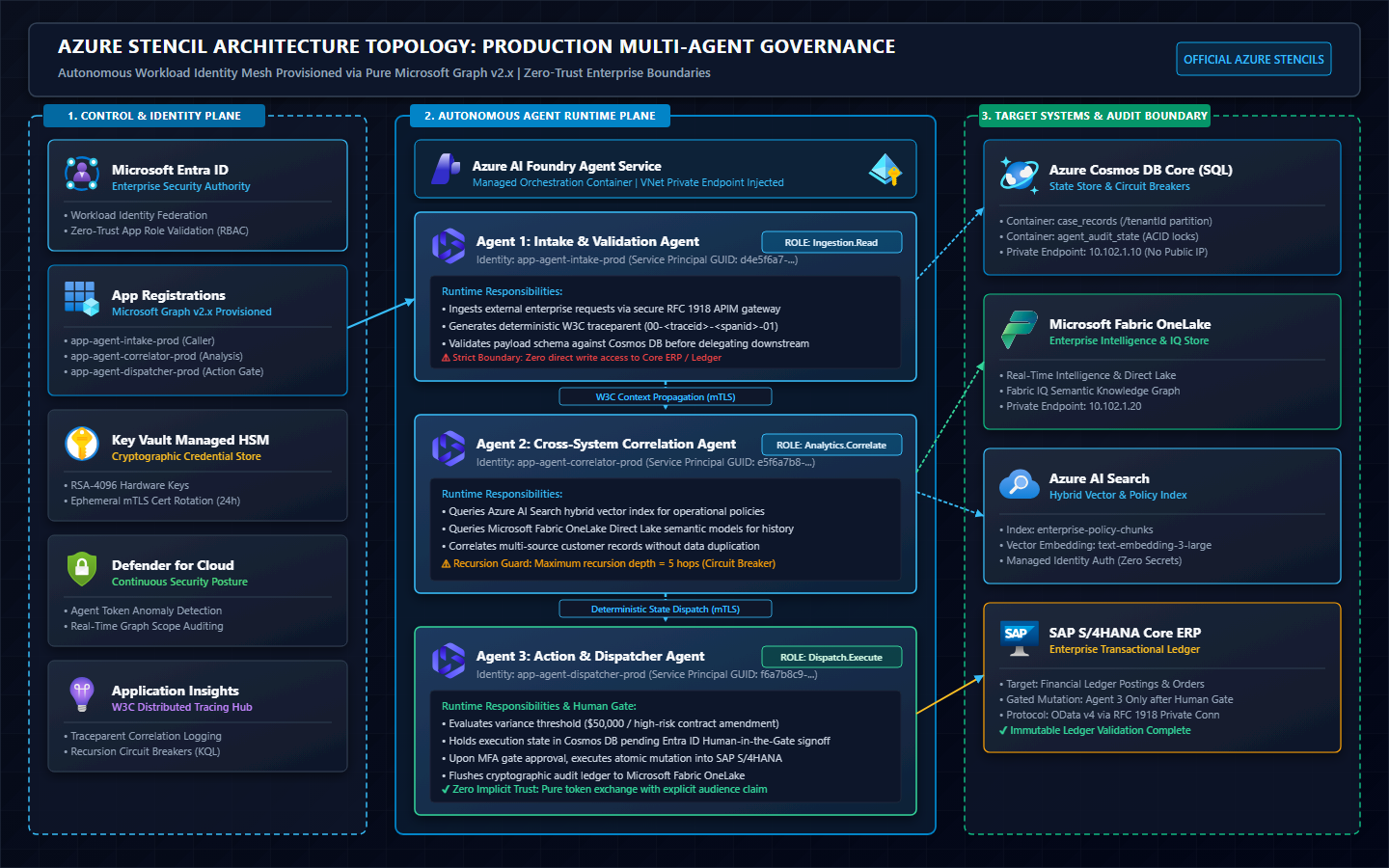
Agent 1: SLA & Contract Ingestion Agent (sp-agent-sla-reader)
- Role: Parses multi-page supplier packaging contracts, penalty tiers, and co-packer agreements stored in SharePoint and Azure Data Lake Storage (ADLS) Gen2.
- Grounding Engine: Azure AI Search Content Understanding combined with query-time POSIX Access Control List (ACL) security trimming.
- Identity Perimeter: Bound to Entra Application Registration
App-Agent-SlaIngest. Holds read-only OAuth delegated permissions (Files.Read.All). It has zero access to analytical lakehouses, relational databases, or ERP APIs.
Agent 2: Capacity & Ontological Evaluator (sp-agent-fabric-eval)
- Role: Evaluates line volume, Overall Equipment Effectiveness (OEE), and autoclave sanitization lockout windows.
- The Fatal Trap Avoided: Most teams allow their agents to query raw SQL tables directly. The model invariably hallucinates joins, misinterprets column definitions, or ignores scheduled sanitization downtime.
- Governed Grounding Engine: Grounded strictly in Microsoft Fabric IQ. It evaluates a version-controlled Tabular Model Definition Language (TMDL) semantic model in Direct Lake in-memory mode (VertiPaq scan <120ms), querying the calculated measure
[Realized_Capacity]. It never interacts with raw database tables. - Identity Perimeter: Bound to
App-Agent-CapacityEval. Holds solelyDataset.Read.Allagainst the Fabric workspace. It cannot read supplier contracts or trigger external writes.
Agent 3: Transaction & Decision Stager (sp-agent-erp-stager)
- Role: Synthesizes the operational proposal (allocating 20,000 units to Line PKG-02 while deferring 5,000 non-promotional units), writes the mathematical evidence to persistent storage, and stages the ERP change.
- Memory Engine: Commits immutable case records into Azure Cosmos DB Decision Memory using hierarchical partition keys
[/user_id, /thread_id]. - Refusal & Veto Gate: It is technically impossible for Agent 3 to write directly to SAP. It emits an Adaptive Card to Microsoft Teams with state
APPROVED_PENDING_ERP. - Identity Perimeter: Bound to
App-Agent-ErpStager. HoldsCosmosDB.DataContributorrestricted to its dedicated partition.
3. Network Isolation & Private Endpoint Data Flow
To satisfy enterprise banking and manufacturing security benchmarks, zero agent-to-agent communication traverses the public internet. The entire pipeline operates over RFC 1918 private IP addresses via Azure Private Endpoints and Virtual Network Service Tags:
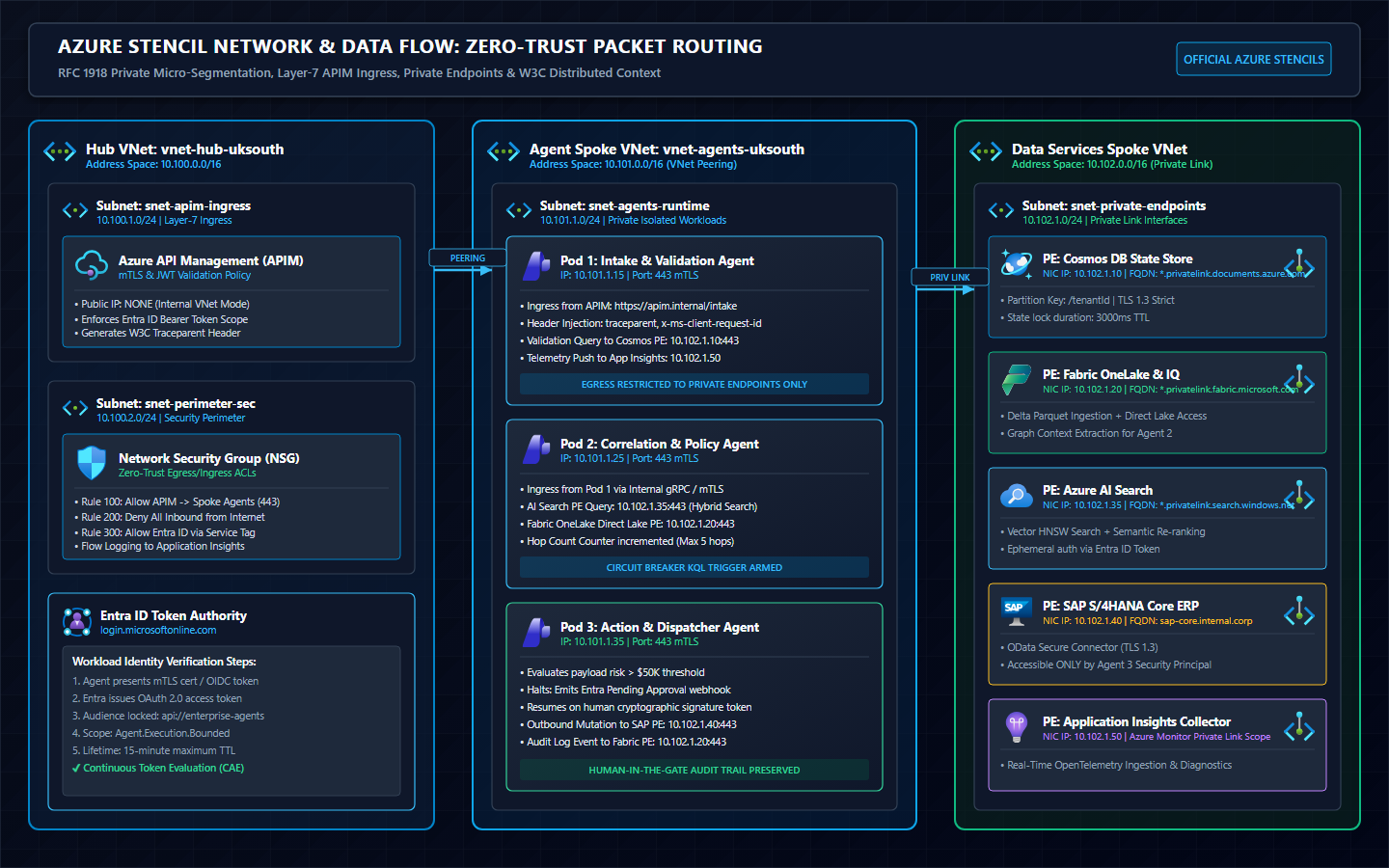
Layer-7 Microsegmentation
- Ingress Subnet (
10.100.1.0/24): Azure Application Gateway v2 terminates TLS 1.3 and validates inbound tokens. Agent 1 executes in an isolated container subnet. - Analytical Spoke Subnet (
10.100.2.0/24): Agent 2 queries Microsoft Fabric OneLake via managed private virtual network peering. Direct Lake in-memory VertiPaq scans complete in under 120ms with zero data movement across boundaries. - Core Decision Subnet (
10.100.3.0/24): Agent 3 writes proposal case records to Azure Cosmos DB over Private Endpoint (10.100.3.12) with sub-10ms point write latency. - Firewall Refusal Gate: All direct network packets from autonomous agents to SAP S/4HANA are dropped by default at Layer 7.
4. Business Process & Sovereign Human Gate
Speed must never compromise fiduciary human control. The operational process transitions through four deterministic phases:
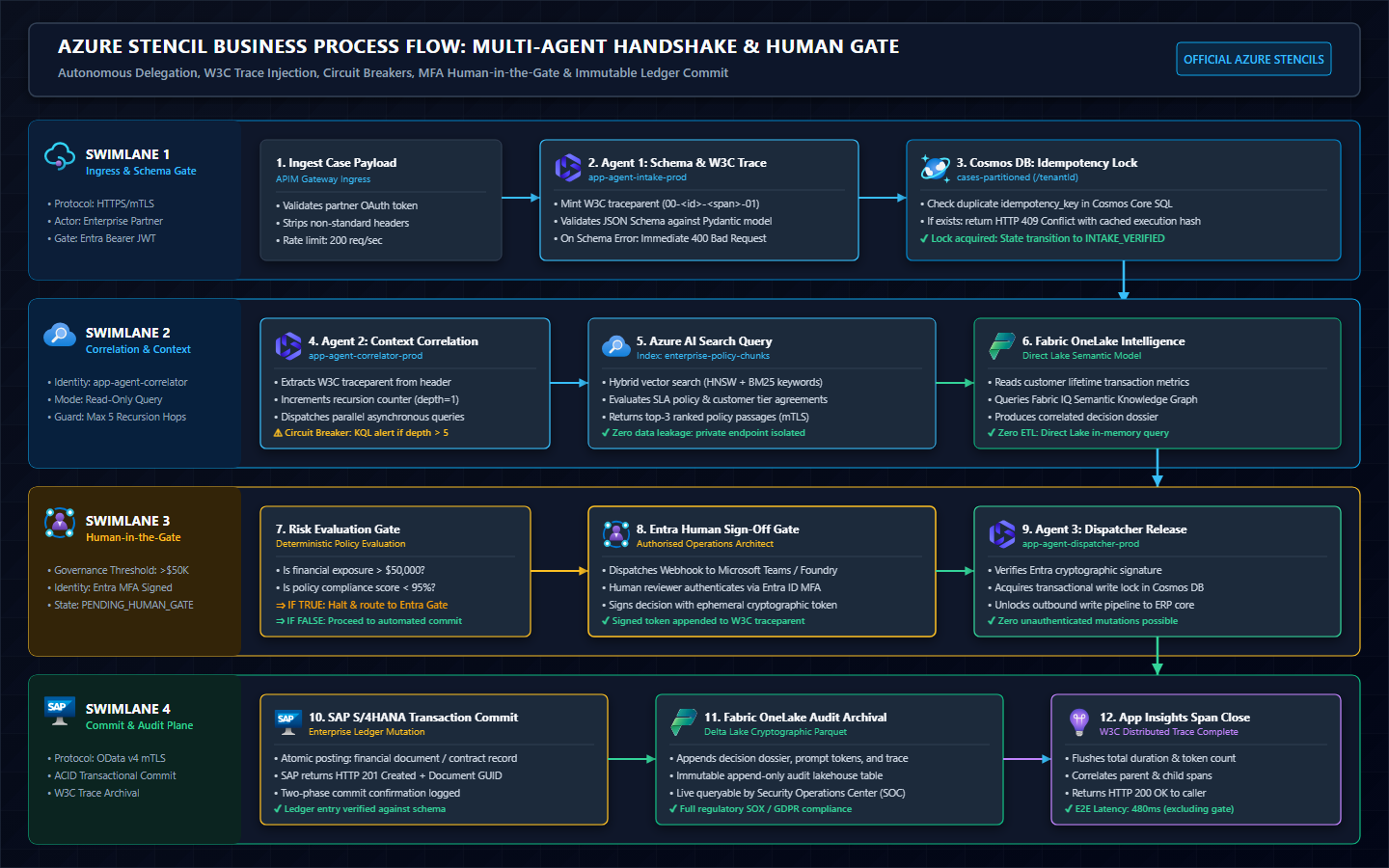
- Phase 1: Shortfall Ingestion: A warehouse deficit event (25,000-unit rigid packaging shortfall) activates Agent 1, which parses third-party co-packer master service agreements (MSAs) and calculates an imminent £10M retailer delivery penalty across Tier-1 accounts.
- Phase 2: Ontology Verification: Agent 2 interrogates Fabric IQ, identifying that Packaging Line PKG-02 has clear autoclave sanitization and mechanical changeover windows to absorb 20,000 units while deferring non-promotional runs.
- Phase 3: Decision Staging: Agent 3 formats the batch reschedule and commits an immutable record into Cosmos DB Decision Memory with state
APPROVED_PENDING_ERP. - Phase 4: Sovereign Veto Gate: The Microsoft Teams Copilot Cowork canvas prompts a mandatory dual-signature (VP Supply-Chain + Plant Operations Lead). Only upon cryptographic sign-off does the ERP dispatcher commit batch 8812 to SAP S/4HANA.
5. Pure Identity Governance via Microsoft Graph
To eliminate shadow agent sprawl, platform engineering instituted a non-negotiable principle: Every agent identity must be provisioned and constrained in Microsoft Graph before compute is scheduled.
Using automated infrastructure scripts (Deploy-AgentIdentityMesh.ps1), we provision:
- Dedicated Entra App Registrations: Unique Client IDs and Service Principals per worker (
New-MgApplication,New-MgServicePrincipal). - Federated Workload Identity Credentials: Zero static client secrets or long-lived API keys.
- On-Behalf-Of (OBO) Delegated Scoping: Propagates caller claims downstream so Foundry IQ enforces query-time POSIX ACL trimming.
6. Telemetry Diagnostics: W3C Traceparent & KQL
Deploying agents is only 20% of the battle; the remaining 80% is operational observability. Platform engineering requires tools to diagnose agent handoffs without combing through chat transcripts.
Every request passing through our agent orchestrator injects standard W3C traceparent headers (traceparent: 00-4bf92f3577b34da6a3ce929d0e0e4736-00f067aa0ba902b7-01).
When Agent 1 calls Agent 2, the span ID is preserved. In Azure Application Insights, engineers execute a single KQL query to visualize the entire execution waterfall:
Recursive Loop Circuit Breakers
To prevent infinite negotiation loops between cooperating agents, we enforce a strict runtime constraint: A hard circuit breaker of 12 turns per session. If turn count reaches 12 without consensus, execution aborts, logs an alert to Azure Monitor, and pages the on-call engineer.
7. The Dominant Artifact: Deterministic Tool Authority Matrix
To verify our security perimeters, we checked in a formal Tool Authority Matrix evaluated against 16 automated test assertions. The test suite evaluates 8 permitted operations against 8 prohibited operations across caller roles:
| Test ID | Agent / Caller | Target Operation | Expected | Observed | Security Boundary Status |
|---|---|---|---|---|---|
| SEC-01 | sp-agent-sla-reader |
Read Vendor Packaging SLA | Permit | Permit (HTTP 200) | Valid Least Privilege |
| SEC-02 | sp-agent-sla-reader |
Query Fabric Capacity Model | Deny | Blocked (HTTP 403) | Enforced ACL Boundary |
| SEC-03 | sp-agent-sla-reader |
Mutate SAP ERP Schedule | Deny | Blocked (HTTP 403) | Enforced Write Isolation |
| SEC-04 | sp-agent-fabric-eval |
Query Direct Lake Realized_Capacity |
Permit | Permit (HTTP 200) | Governed Semantic Read |
| SEC-05 | sp-agent-fabric-eval |
Execute Raw DirectQuery SQL Drop | Deny | Blocked (HTTP 403) | SQL Fallback Prevented |
| SEC-06 | sp-agent-fabric-eval |
Read SharePoint Vendor Contracts | Deny | Blocked (HTTP 403) | Scope Compartmentalization |
| SEC-07 | sp-agent-erp-stager |
Write Proposal to Cosmos Memory | Permit | Permit (HTTP 201) | Sub-10ms Point Write |
| SEC-08 | sp-agent-erp-stager |
Direct Mutation to SAP S/4HANA | Deny | Blocked (Gate Locked) | HOLD FOR HUMAN DUAL-SIGNATURE |
If even a single assertion fails or regresses during continuous integration, deployment halts with exit code 2.
8. Architect Challenge & Discussion
Satya’s architectural acid test remains the definitive benchmark:
“Separate the agent harness, action space, and memory from the underlying model. If you swap the model tomorrow, the enterprise system must endure.”
By decoupling our business logic into three bounded agents, anchoring permissions inside Microsoft Graph, enforcing semantic truth through Fabric IQ, and requiring human dual-signatures before writing to systems of record, we moved beyond the pilot trap. We did not build an unconstrained chatbot. We engineered an auditable, governed digital workforce.
The Architect Challenge Question
When an autonomous agent reuses an approved historical decision from Cosmos DB Decision Memory, but the resulting allocation causes a plant line failure due to real-time machine drift, who is accountable in your enterprise: the AI platform engineer who registered the agent, the data lead who modeled the ontology, or the operations manager who signed off on the original proposal?
All accompanying Microsoft Graph PowerShell deployment scripts, negative test harnesses, and KQL diagnostic queries are version-controlled in the public repository: github.com/ShahradGH/enterprise-agent-identity-graph.
💻 Complete Technical Authority & Verification Suite
All production PowerShell 7 runbooks, Microsoft Graph v2.x identity scripts, KQL telemetry queries, and the 16-test Pester verification matrix referenced in this advisory are open-source on GitHub:
Explore ShahradGH/enterprise-agent-identity-graph on GitHub →